


Lagniappe
“A little something extra”
September 24, 2026

Why Gen Z Is Lost
By: Jim Reynolds
Jim’s Note:
I made a mistake yesterday.
To my surprise, nobody has complained about it yet. Here is my mea culpa.
In Rip’s Newsletter I sent out an article that I thought addressed an immensely important subject. It did. But I also sent it out knowing that the argument was buried inside an almost impossibly dense academic treatment.
I should have done the work first.
Because the more I wrestled with the essay, the more convinced I became that the underlying idea mattered—and the more frustrated I became that something this important had been made so difficult to understand.
So consider this my second try.
Not at summarizing the article. At finding the important thing buried inside it.
Before getting into that, I should say something about the author.
Renaud Beauchard is not some random internet crank. He is a French journalist and lawyer with serious academic credentials, including degrees from Tulane and Cambridge, and he has taught law at American University. He is obviously intelligent, widely read, and interested in large questions about culture, technology, and society.
Which may explain why his essay irritated me so much.
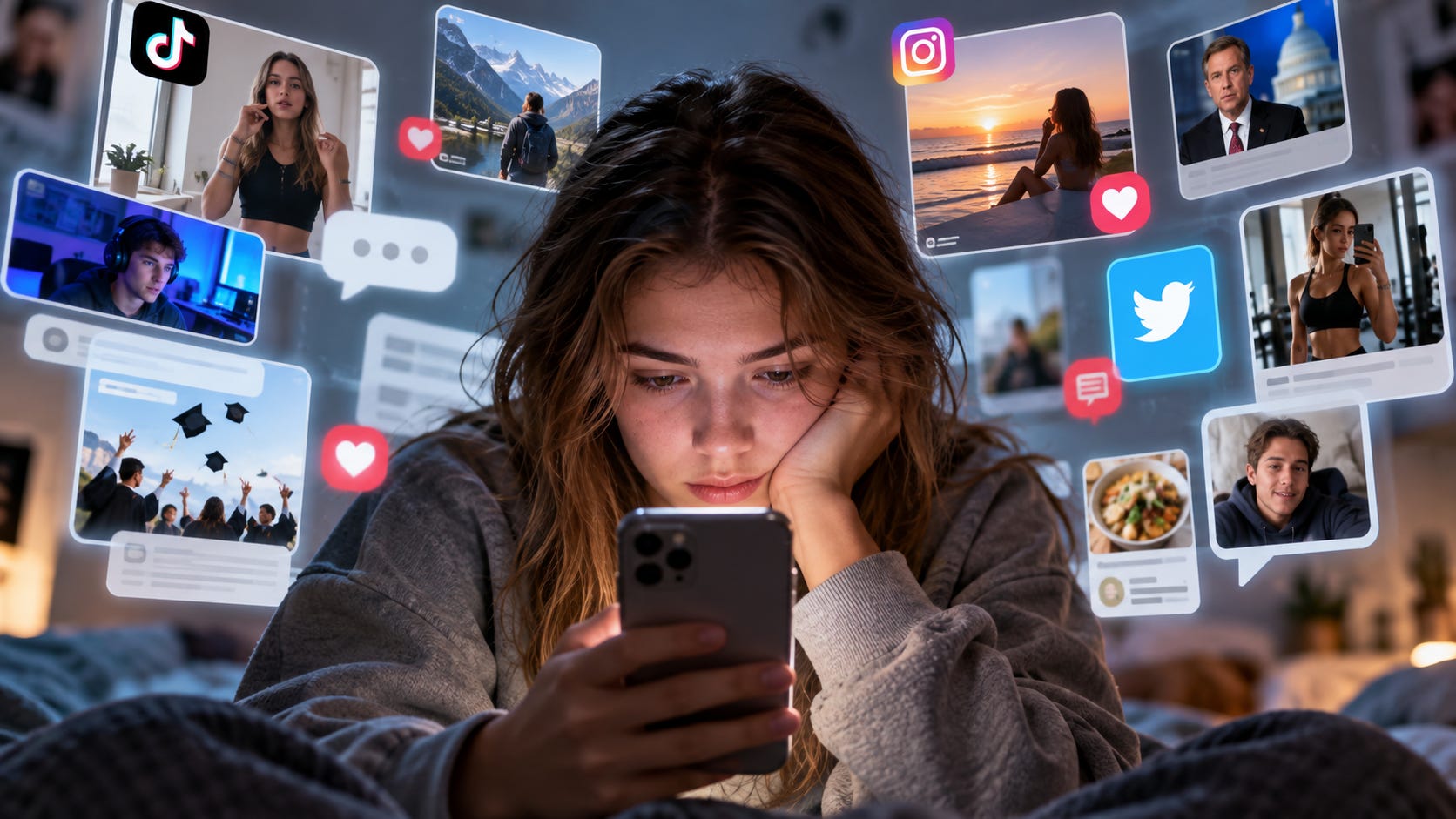
I started reading The Commodified Self and the Designed Collapse of Generation Z because I thought he was onto something important. Very important, in fact. We have an entire generation growing up inside a technological and social environment unlike anything human beings have experienced before. Their attention is being harvested. Their social lives are increasingly mediated through screens. Their identities are being shaped in public, measured by clicks, likes, followers, and algorithms.
Something consequential is happening here, and Beauchard clearly sees it.
But every time I thought I had hold of his argument, he seemed determined to make it harder to understand.
Another theorist appeared. Then another abstraction. Then came the ego, competing selves, commodification, philosophical frameworks, and layers of terminology that required the reader to keep translating the essay back into ordinary English.
By the time I got to the internal struggle among various versions of the self, I was nearly done.
This kind of writing embodies almost everything I try not to do.
Writing should clarify an idea, not advertise the complexity of the writer’s thinking. If an argument is important, the obligation is to make it clearer. Strip away what isn’t necessary. Explain unfamiliar ideas in familiar language. Give the reader evidence. Connect the pieces. Move.
Clear. Concise. Informative. Comprehensible.
Beauchard had, I think, identified something enormously important. But he buried it under so much intellectual machinery that the machinery began competing with the message.
So I decided to take the essay apart. That’s what engineers do. We take complex things and break them into understandable smaller pieces.
The goal was not to summarize it. Nor was it to translate it paragraph by paragraph. I certainly had no interest in reproducing all of its philosophical scaffolding.
I wanted to find the thing underneath it.
I call it The Chunk.
And once you strip everything else away, the question is remarkably simple—and disturbing:
What happens to a generation when we turn childhood, friendship, status, sexuality, identity, and attention into products—and then hand the machinery to companies that make more money the harder it becomes to look away?

Why Gen Z Is Lost
We weakened the institutions that once helped children become adults. The marketplace was happy to take their place.
By Jim Reynolds | www.reynolds.com
September 24, 2026
So what was Beauchard actually trying to tell us?
Because by the time Beauchard had taken me through the philosophers, the psychological categories, the ego, the superego and competing versions of the self, I had begun to wonder whether understanding why our kids are miserable really required a graduate seminar in psychoanalysis.
It doesn’t.
Underneath all the intellectual machinery is a much simpler and more disturbing idea.
For decades, we have been weakening many of the institutions that once helped young people understand who they were, what was expected of them and what adulthood was supposed to look like.
Family authority weakened. Religious authority declined. Communities became thinner. Traditions were increasingly treated not as inherited wisdom to be examined and adapted, but as restraints from which the individual should be liberated. Adults became more hesitant to tell children what they ought to believe, how they ought to behave or even what kind of person they ought to become.
The intentions were often good. Older forms of authority could be rigid, unfair or simply wrong. Parents could be domineering. Churches could become ossified. Communities could enforce foolish conventions. Much of the cultural revolution of the past half-century was an understandable reaction against those excesses.
But we rarely paused to ask the obvious follow-up question:
If the old institutions stopped telling children who they were and how they fit into the world, who would take their place?
We now know the answer.
Companies did.
Social media did.
The therapeutic industry did.
Algorithms did.
And they were extraordinarily good at it.
For most of human history, a child did not begin life as an autonomous consumer constructing an identity from an infinite menu of possibilities. The world arrived first. There was a family, a neighborhood, a religion, a school, a community, a set of expectations and an assortment of adults who had already lived long enough to know a few things. The child might eventually reject some of those things, but first he had something against which to push.
In this scenario, identity emerged from membership, obligation, imitation, resistance and experience.
That structure has steadily weakened. We increasingly told young people that they should discover themselves, define themselves and refuse to be limited by inherited expectations. The child was encouraged to look inward for identity rather than outward toward family, tradition, community and responsibility. It sounded liberating. But there was a problem: children do not arrive equipped with a mature understanding of who they are or what is worth wanting. They are highly suggestible human beings attempting to construct themselves while surrounded by other highly suggestible human beings doing exactly the same thing.
Into that vacuum stepped the marketplace.
Companies had always sold things to teenagers, of course. Clothing, records, cosmetics, cars and every other product associated with youth culture have been marketed to young people for generations. But something fundamentally changed when technology allowed companies to move from selling things to the young to participating continuously in the construction of the young person’s identity itself.
The beauty industry could now tell a girl what her face ought to look like, and software could immediately show her the corrected version. Social media could tell her how popular she was in numerical terms. Dating apps could turn desirability into a swipe. Pornography could establish expectations about sex before many children had experienced a real romantic relationship. Influencers could provide ready-made identities, political beliefs, diets, aesthetics, emotional vocabularies and lifestyles. The phone became part parent, part mirror, part marketplace and part scoreboard.
And it never went to sleep.
This is what makes the change so profound. A young person’s face can now be improved, body optimized, popularity measured, friendships counted, desirability rated, moods tracked, unhappiness labeled and identity publicly displayed. Nearly every one of these processes has a commercial system attached to it. The more uncertain the young person becomes, the more products, services and advice can be offered to solve the uncertainty.
The teenager is no longer merely the customer.
The teenager’s identity has become the product.
At roughly the same time, another cultural shift was taking place. We began interpreting more and more of ordinary human experience through a therapeutic lens. This requires some care, because real mental illness exists. Depression exists. Anxiety disorders exist. Trauma exists. There are children and adults who urgently need psychiatric care, medication and professional treatment. Nothing in this argument disputes that.
The question is what happens when an entire culture becomes intensely preoccupied with its own emotional state. Sadness is no longer simply sadness; it must be examined for pathology. Shyness becomes anxiety. Difficulty concentrating may become a disorder. A bad relationship becomes toxic. A painful episode becomes trauma. Ordinary discomfort acquires a vocabulary once reserved for illness. A diagnosis can gradually move from describing a problem a person has to describing the person himself.
That change also created a marketplace. Therapists, apps, pharmaceutical companies, online communities, influencers, self-help programs and mental-health subscriptions all have roles to play, some useful and some questionable. But taken together, they encourage a remarkable amount of attention to the self. Young people are continually invited to ask how they feel, what their feelings mean, what diagnosis might explain them and what intervention might make them feel better.
Yet during the same period, young people appear to have become increasingly anxious about how they feel.
Perhaps those trends are not entirely unrelated.
Human beings are affected by what they are trained to notice. A person encouraged to monitor every change in mood may become exquisitely sensitive to changes in mood. Someone taught that discomfort may signify damage can begin to interpret ordinary friction as danger. The person who spends all day examining his inner state may eventually discover an astonishing number of things wrong with his inner state.
Meanwhile, many of the institutions that once pulled people outward have weakened. Family obligations require us to think about other people. Work imposes duties whether we feel inspired or not. Religion places the individual inside a larger moral order. Community creates reciprocal expectations. Service forces attention away from the self. Even boredom once forced children to make something happen rather than wait for a device to stimulate them.
Those things may have been doing more psychological work than we understood.
This is also why the fashionable explanation that smartphones caused the entire crisis seems incomplete. Smartphones clearly matter. Social media clearly matters. Pornography, algorithmic feeds and endless digital stimulation clearly matter. But the phone did not create every weakness that made young people vulnerable to those forces.
It industrialized them.
Imagine giving a 12-year-old a device containing a beauty contest, a popularity ranking, a pornography library, an advertising platform, a psychological clinic, a political rally, a peer-surveillance network and an infinite shopping mall. Then imagine that the device studies the child continuously, learns what frightens him, excites him, angers him and holds his attention, and then adjusts what it shows him accordingly.
That is approximately what we did.
And we did it at precisely the moment when many of the competing influences—parents, churches, neighborhoods, civic organizations and other forms of adult authority—were becoming weaker.
The timing could hardly have been worse.
This helps explain another apparent paradox of Generation Z. Young people possess more freedom of personal choice than previous generations could have imagined. They can choose among lifestyles, identities, careers, communities, relationships and forms of self-expression that barely existed a generation ago. Yet many seem not liberated by this abundance but overwhelmed by it.
Unlimited choice can become its own burden. A young person who may theoretically become anything must first decide what is worth becoming. A culture that refuses to give him much guidance because guidance itself is regarded as coercive has not necessarily made him freer. It may simply have given him an impossible assignment.
Human beings seem to need boundaries, standards and models. Not prison walls. Boundaries. A child needs some things that are fixed long enough to allow character to form against them. He needs adults who are willing to say that some things are better than others, that some impulses should be resisted, that some duties exist regardless of mood and that adulthood requires accepting responsibilities that were not individually designed for our convenience.
This is where adults return to the story.
Children need adults willing to say no. They need adults willing to be disliked. They need communities that do not exist merely to validate them. They need obligations they did not create and cannot swipe away. They need work that cannot be filtered, friendships that cannot be measured in followers and accomplishments that cannot be awarded with a click.
They probably also need some answer to the oldest human questions.
Who am I?
What do I owe other people?
What is worth sacrificing for?
What does a good life look like?
What do I do when I fail?
Religion historically supplied answers to many of those questions through community, ritual, moral structure, obligation, forgiveness and purpose. A secular society may decide that it does not need religion. But it does not get to decide that it no longer needs answers to the questions religion once addressed.
The vacuum remains.
And the phone has answers.
That should concern us because the answers delivered through the phone are rarely neutral. They are selected by systems designed to obtain something from the user: attention, money, data, engagement, loyalty or dependence. The young person may believe he is discovering himself while moving through a carefully engineered marketplace designed to keep him searching.
We spent years worrying that corporations were selling things to our children.
We may have missed the larger change.
They began selling our children themselves.
A better face. A better body. A better identity. A diagnosis. A following. A personal brand.
Perhaps the mental-health crisis is not as mysterious as it sometimes appears. We weakened many of the institutions that once helped children become adults, replaced inherited structure with personal choice, medicalized a growing share of ordinary emotional life and then handed every child a machine designed to monetize insecurity.
Then we wondered why they were anxious.
We removed the adults from the room.
The marketplace was happy to take their place.
Please go to www.reynolds.com to see more of Jim’s articles.

Another well assembled piece on an important subject. Thank you for that Jim.
I passed it on to my daughters who are raising kids born into this, Gen Z, time frame. Fortunately all 3 grandkids seem to have established a healthy balance between the screen & the real world. It seems, many do not.