


Rip’s Newsletter
November 6, 2026
DEEP RIP EDITION
Compiled and Edited
by
Jim Reynolds

Articles in This Issue
Kevin McCullough - What America Wants, and What We Don’t
John Hinderaker - What Happened? Turnout
Breccan F Thies - Exclusive: DOJ Stops Race-Based Funding For Fed Student Aid
Jim Reynolds - The Other Legacy of Hope and Change
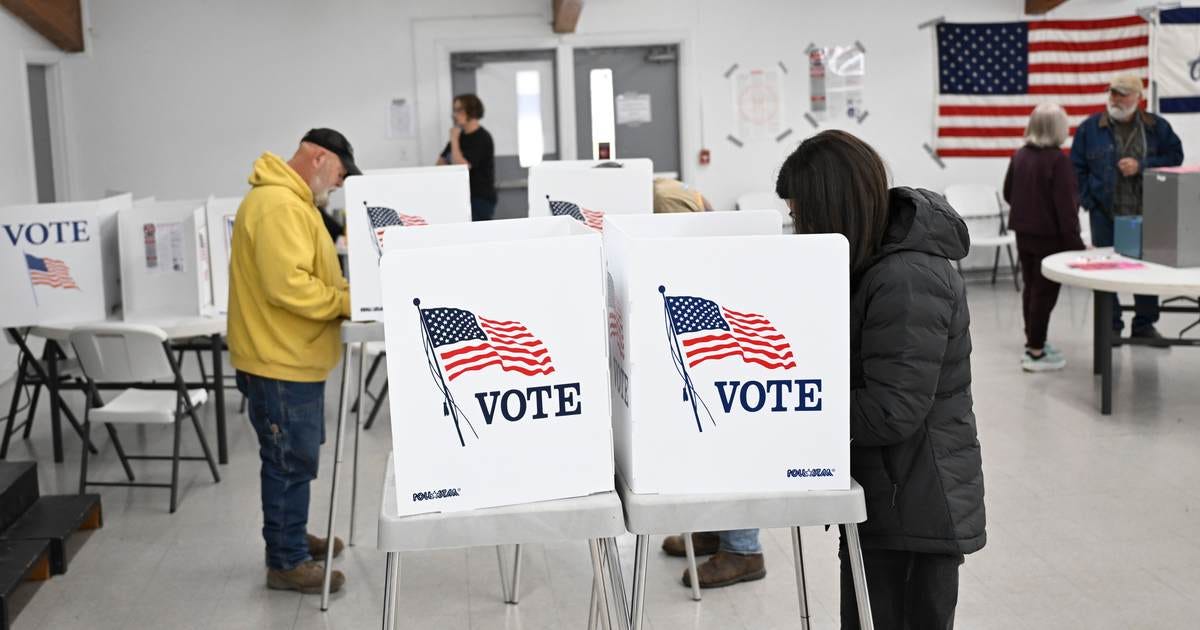
What America Wants, and What We Don’t
By: Kevin McCullough Townhall
Date: 2026-11-05 · Words: 904
Republicans suffered a harsh defeat, prompting GOP autopsies and 2028 positioning.
The author blames voters’ backlash largely on Iran war fatigue and gas prices.
He argues Trump still pursued principle, not poll-chasing, despite the election loss.
Some conservative priorities advanced: voter ID, citizens-only voting, and school sports restrictions.
He says the result was a veto, not conversion, and America will recover.
This story shows how GOP losses reflect war fatigue and affordability concerns more than rejection of conservative principles.
Skip the discussion — the article, or a short preview first:
Discussion
The gas-station sign does more work here than any abstract theory about “affordability.” By pinning the election to a number that changed in public view from $2.98 to $4.15, the piece turns a national verdict into something voters could literally watch every day. That matters because it gives the argument a concrete mechanism: not just that prices were high, but that they were visible, cumulative, and hard to separate from the administration in power. The same is true of the war argument. The article keeps returning to the gap between the original promise — a short, decisive operation — and the reality of an eight-month conflict. That mismatch is the hinge of the whole piece. It is not saying voters rejected the underlying goal of stopping Iran; it is saying they rejected the duration, the drag, and the political cost of a war that no longer felt like the thing they were told it would be.
That framing also explains why the piece can hold two ideas at once: that the policy was right, and that the electorate still punished it. Those are not treated as contradictory. Instead, the election is read as a veto on pace and consequence, not on principle. That is why the article spends so much time distinguishing Trump from a poll-chaser. The point is less about his motives than about the kind of political actor he is presented as being: someone willing to absorb a loss rather than reverse course for immediate approval. Once that distinction is in place, the rest of the column becomes a sorting exercise. Some conservative priorities survived, some Republican candidates won by governing rather than posturing, and some losses are treated as temporary turbulence rather than ideological collapse. The throughline is that the coalition was not repudiated wholesale; it was told, in effect, that patience has limits.
🅱️ The voters didn’t need a seminar; they had the gas pump and the calendar, and both were keeping score.

What Happened? Turnout
By: John Hinderaker Power Line
Date: 2026-11-06 · Words: 659
Vance argued Republicans lost because Trump voters defected to Democrats, not because turnout collapsed.
The author says that explanation is wrong; Republican turnout held near prior midterm levels.
Minnesota data show GOP votes matched 2022, while Democrats matched presidential-year 2024 totals.
Broader analysis across 11 states suggests most Democratic gains came from turnout, not switching.
Even where more voters switched Republican, Democratic turnout overwhelmed those crossover losses.
This story shows Democratic midterm gains were driven mainly by turnout, not widespread Republican voter defection.
Skip the discussion — the article, or a short preview first:
Discussion
The Minnesota comparison does a lot of work because it puts the argument on a cleaner footing than the national rhetoric. Matching 2022 on the Republican side while Democrats match 2024 is a stark asymmetry: it suggests the GOP did not suffer a collapse so much as the Democrats managed to drag presidential-year participation into an off-year contest. That is a different story from “Trump voters defected,” because it separates volume from loyalty. The same pattern repeated across offices, which matters because it makes the result look less like a quirk of one race and more like a broad turnout environment.
The Bronner data sharpen that point by adding a second layer: even where some 2024 Democratic voters crossed over, the net effect still came from the size of the Democratic electorate. In other words, switching was real, but it was not the main engine. That distinction is easy to blur in post-election commentary because a visible handful of defections is more narratively satisfying than a turnout gap, yet the latter can overwhelm the former. The article’s real claim is not just that turnout mattered, but that turnout can dominate even in places where the cross-current runs the other way.
🅱️ The ugly little arithmetic here is that a few defections make a good story, but a turnout gap makes the result.

Exclusive: DOJ Stops Race-Based Funding For Fed Student Aid
By: Breccan F Thies The Federalist
Date: 2026-11-05 · Words: 839
DOJ says federal education aid cannot be tied to race-based diversity initiatives.
Opinion targets Education Department’s Magnet Schools Assistance Program as racially discriminatory.
DOJ says MSAP prioritizes racial composition over educational need or school quality.
Program triggers strict scrutiny; DOJ says current practice is likely unconstitutional.
Rulings and examples show grants have rewarded racial balancing and isolation efforts.
This story shows DOJ is moving to block race-based federal student aid and challenge magnet-school funding rules.
Skip the discussion — the article, or a short preview first:
Discussion
The opinion’s most revealing move is the way it recasts a familiar education program as a sorting mechanism. Magnet schools are usually defended as a vehicle for choice and academic improvement, but the legal analysis says the operative criterion is not need, quality, or even school performance; it is racial composition. That matters because it changes the program’s character from one that incidentally considers race to one that is built around race as the organizing principle. Once that is visible, the constitutional problem is not a side issue but the program’s design.
The examples sharpen that point. A grant aimed at reducing “Hispanic/Latino isolation” by a set percentage, or a recruitment plan built to alter “racial balances,” shows how bureaucratic language turns racial engineering into administrative routine. The opinion’s comparison to a hypothetical program that rewarded racial isolation does useful work here: it exposes how little distance there is, in constitutional terms, between “diversity” and “balancing” when the government is distributing money on racial lines. The article also quietly shows the tension between the old desegregation framework and the post-SFFA world. What once could be defended as a remedial tool now has to survive a much harsher standard, and the opinion suggests that many voluntary plans cannot. That is the real shift: not just that DOJ is objecting to one grant program, but that a whole category of race-conscious education funding is being forced to justify itself under a constitutional regime that no longer treats racial balancing as a benign public good.
🅱️ When the paperwork starts grading children by color, the “choice” part is just window dressing.
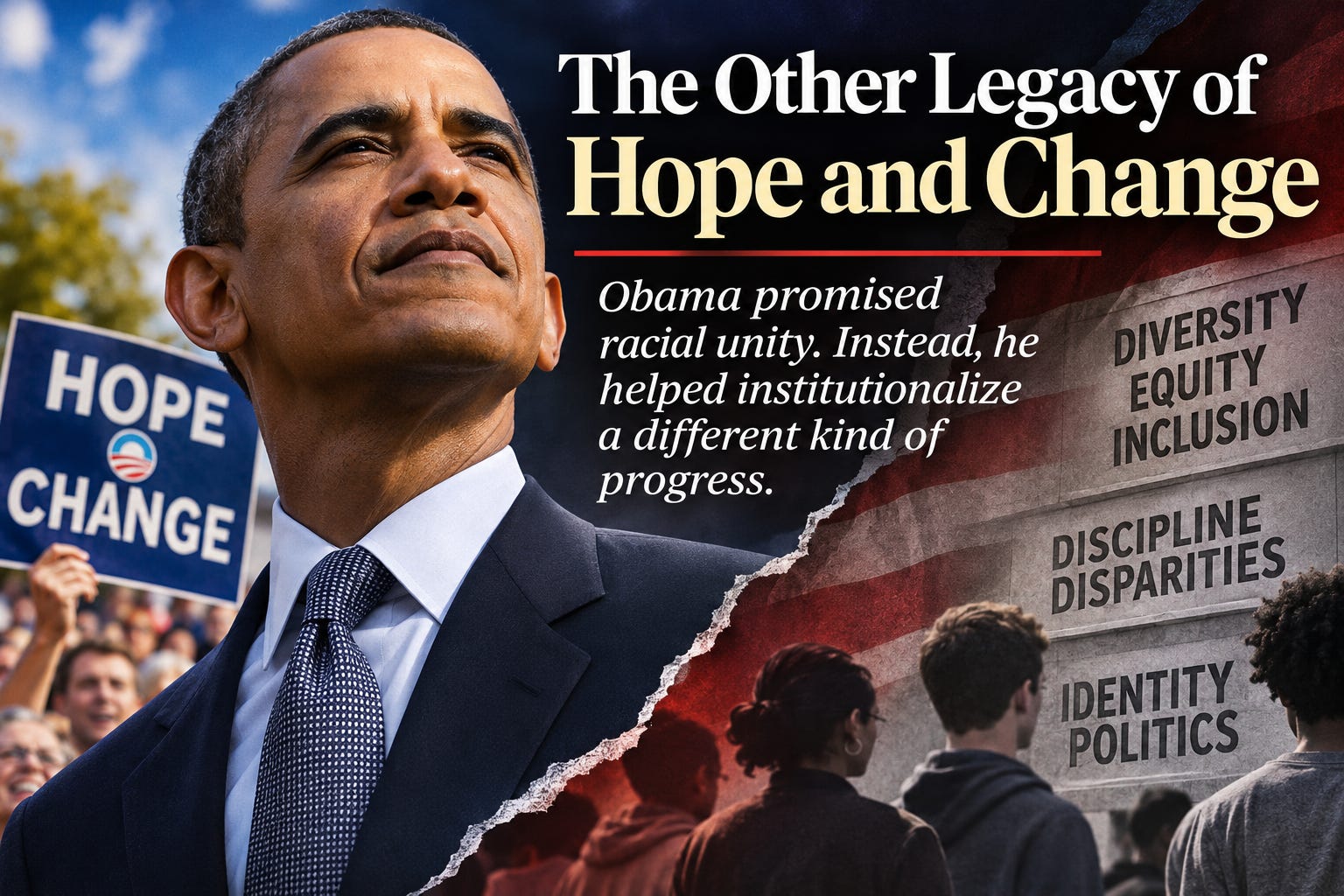
The Other Legacy of Hope and Change
By: Jim Reynolds www.reynolds.com
Date: 2026-11-06 · Words: 1,009
The essay argues Obama’s legacy was not failed unity, but a replacement of that promise.
It says Obama supercharged identity politics through federal diversity and outcome-based policies.
The author contrasts merit-based equality with group-based equalization and institutional intervention.
Quartz’s disillusioned Obama generation is portrayed as misreading a deeper ideological shift.
The piece concludes America chose racial accounting over making race less important.
This story shows how Obama-era politics replaced racial unity with a lasting system of identity-based governance.
Skip the discussion — the article, or a short preview first:
Discussion
The piece’s strongest move is the way it treats Obama’s 2004 “no Black America, no white America” line as a baseline the presidency can be measured against, then sets that against the later federal machinery of diversity, discipline guidance, and outcome monitoring. That contrast does more than accuse him of hypocrisy. It shows a shift in the governing language itself: from race as something the country should outgrow to race as something institutions must continually track, classify, and correct. Once that shift is in view, the argument about “hope and change” becomes less about disappointment than about substitution.
The essay also works by tightening the meaning of meritocracy. It does not simply defend merit as a slogan; it distinguishes between effort and the kind of effort that produces value in a market. That distinction matters because it lets the author concede a real frustration — hard work can still leave people behind — without surrendering the principle that outcomes are not proof of injustice. The Quartz generation’s disillusionment is therefore read not as evidence that merit is fake, but as evidence that they were aiming at a different economy and a different moral story than the one the country was actually moving toward.
What gives the argument its edge is the final reversal: the issue is not only that racial unity failed to arrive, but that the goal itself was displaced. That is a more consequential claim than a standard “Obama fell short” critique. It suggests the presidency helped normalize a permanent administrative logic in which equality means managing group outcomes rather than reducing the salience of group identity. Whether one accepts every policy example or not, the article’s deeper point is that the real legacy is not broken promise but changed destination.
🅱️ The trick wasn’t that unity failed to show up; it’s that the country quietly got handed a new job description, and now the paperwork never ends.
You may also be interested in the following selected stories:
Democrats Are About to Throw Out the Electoral College Without Touching the Constitution — Larry O’Connor, Townhall: Larry O’Connor explains how the National Popular Vote Interstate Compact could let states effectively sidestep the Electoral College by awarding electors to the national popular-vote winner. He argues recent Democratic gains in key states may put the compact within reach before 2028.
No Time to Grieve — Judd Dunning, American Thinker: A conservative argument for using the remaining lame-duck days to confirm judges, pass permitting and defense bills, force budget votes, and lock in state-level protections before Democrats take control. It also urges aggressive oversight and corruption investigations while the current majority still has power.
Where The Hammer Sleeps — Lars Møller, American Thinker: An essay contrasts Charles Martel’s victory at Tours with present-day Seine-Saint-Denis, arguing that demographic change and elite ideology have weakened France’s historic Christian culture. It uses the basilica of Saint-Denis as a symbol of a civilization losing its public inheritance.
Selling Humanity Short — Michael Smith Contributor, The Patriot Post: An argument that modern doom-mongers profit by exaggerating threats to civilization, using climate, energy, and technology scares to justify more government power. It traces how that mindset shapes policy, especially in California, and why human ingenuity keeps disproving the predictions.
Colorado Parents Teach A Powerful Lesson About Political Victory — Chris Bray, The Federalist: Colorado ballot measures on transgender sports, minors’ surgeries, and sex trafficking passed despite a leftward statewide shift, driven by a parent-led coalition that crossed ideological lines and relied on volunteers, churches, and local persuasion. It shows how organizers turned a failed 2024 effort into a 2026 victory.
Neocons Blame Midterm Wipeout On Everything But Iran — John Daniel Davidson, The Federalist: The essay argues that Republicans’ midterm wipeout was driven mainly by the unpopular Iran war and its economic fallout, not tariffs or corruption. It is worth reading for its account of how neoconservatives are trying to redirect blame and for the exit-poll evidence it cites.
JD Vance Is Absolutely Right and Completely Wrong — James H. McGee, The American Spectator: James H. McGee argues that the Iran war drove Republican losses, but says JD Vance is wrong to treat that as proof the conflict should end on Tehran’s terms. The piece traces how ceasefires, strikes, and sanctions shaped the war’s politics and its fallout.

Philip, hit the button. That is what it is there for.
AI versions are BS…just give me the real article to read!