Lagniappe
“A little something extra”
October 27, 2026

Did You Miss This Social Security Change?
It could mean thousands of dollars for you or someone you know.
By: Jim Reynolds
October 27, 2026
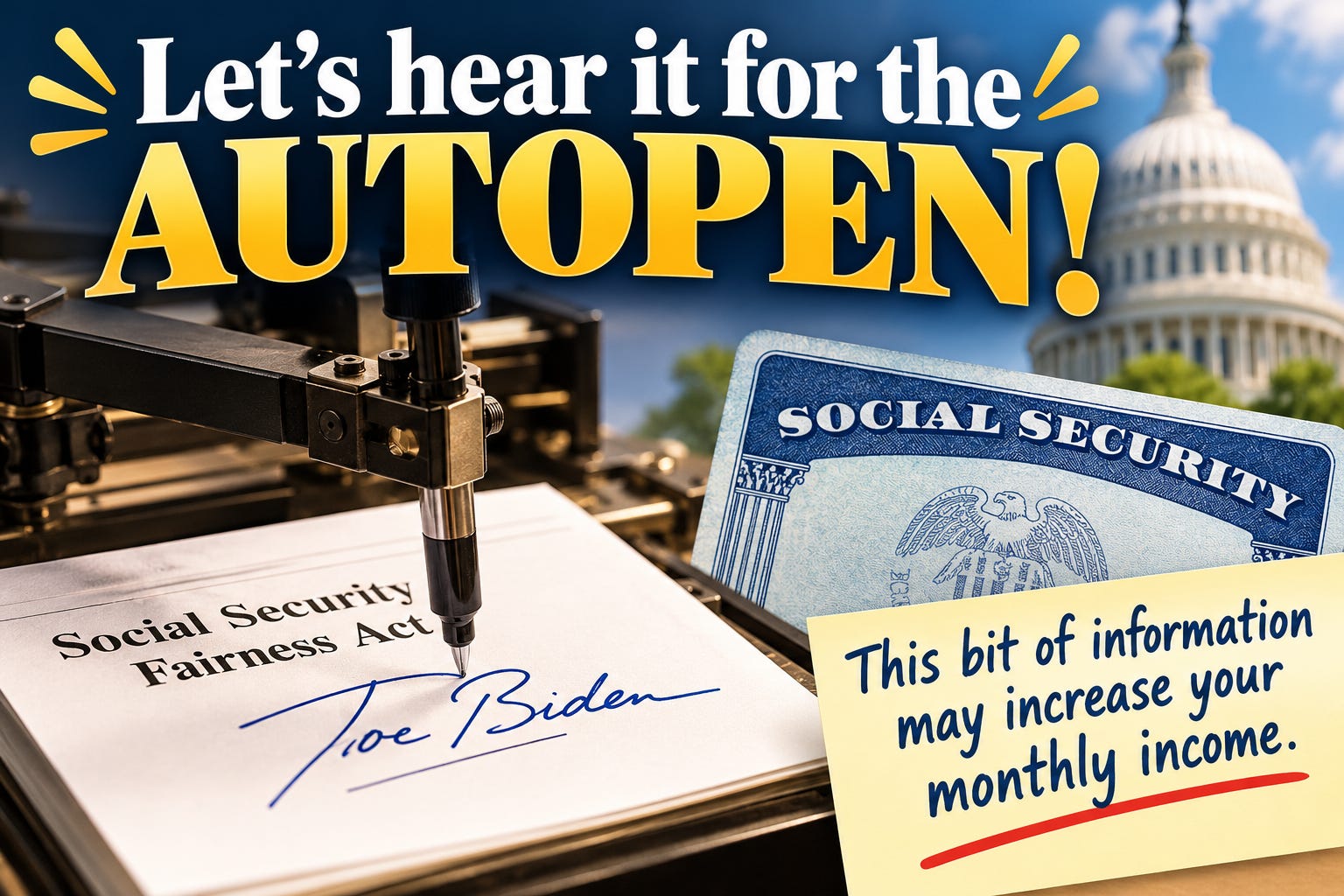
On January 5, 2025, President Joe Biden signed the bipartisan Social Security Fairness Act into law.
The legislation eliminated two provisions that had reduced Social Security benefits for millions of Americans who receive pensions from jobs that did not participate in Social Security.
These include some teachers, firefighters, police officers, and other government employees.
The law has been in effect for nearly two years, but some people who could benefit from it may not even know they qualify.
Here are three examples.
Example 1: The Retired Teacher
Mary taught public school for 25 years and receives a teacher’s pension. She also worked in private industry, paying Social Security taxes for many years.
Under the old rules, her $1,500 monthly Social Security benefit might have been reduced to $900 because of her teacher’s pension.
Under the new law, she receives the full $1,500.
That’s another $600 every month, or $7,200 a year.
Example 2: The Widow
Susan receives a $1,500 monthly pension from her years working for a government agency that did not participate in Social Security.
Her late husband earned a Social Security benefit that would ordinarily entitle her to $2,000 a month in survivor benefits.
Under the old rules, two-thirds of her government pension—$1,000—was deducted from her survivor benefit. She received only $1,000.
The new law eliminates that deduction.
Susan now receives $2,000 a month in survivor benefits—an increase of $12,000 a year.
Both examples are hypothetical. Actual benefits depend on individual circumstances.
Example 3: My Own Household
My wife, Vicki, worked for more than 30 years in a job where she did not contribute to Social Security. She receives a pension from that employment.
I began collecting Social Security at about age 62½, rather than waiting until my full retirement age of 66. That reduced my monthly benefit, a tradeoff I knowingly accepted. For the curious, my “break-even age” is about 78, which I am rapidly approaching.
Like many of you, Social Security was never the primary source of retirement income for us.
Today, I receive $2,350.90 per month.
Here’s something I didn’t fully appreciate until recently.
Although I elected to collect Social Security early, Vicki’s spousal benefit is calculated using 50% of my full-retirement-age benefit, adjusted for subsequent cost-of-living increases.
My decision to retire early doesn’t reduce her spousal benefit.
Vicki is now 76, well past full retirement age, and the repeal of the Government Pension Offset means her pension no longer reduces her Social Security spousal benefit.
We’re expecting her monthly benefit to be in the neighborhood of $1,500, although Social Security will determine the exact amount.
Better still, she will receive six months of retroactive benefits. That could mean approximately $9,000 in back payments, in addition to her new monthly income.
Not bad for discovering a law that was signed nearly two years ago.
What You Should Know
The Social Security Fairness Act took effect retroactively to January 2024. Many people have already received automatic adjustments and back payments.
But if you never applied for Social Security benefits because you believed your government pension would eliminate them, you may need to apply now. Retroactive benefits for new applications are generally limited to six months.
You can read the official explanation here:
Social Security Fairness Act — Social Security Administration
If you worked in a job that did not participate in Social Security, or your spouse did, I encourage you to investigate.
And even if this doesn’t apply to you, consider forwarding this note to someone who might benefit.
If this note helps just one of you recover thousands of dollars a year in benefits you didn’t know you were entitled to, it will have been worth writing.
Jim Reynolds

Addendum
Here are 18 occupations that may have been exempt from paying Social Security taxes, depending on the employer, state, retirement system, and years of employment.
Public education
Public school teachers
Public school principals
Public school superintendents
Public school counselors
Community college instructors
State university professors
Law enforcement and public safety
City police officers
County sheriff’s deputies
State highway patrol officers
Municipal firefighters
Fire department captains and chiefs
Correctional officers
Government employees
Federal civil servants hired before 1984 under the Civil Service Retirement System (CSRS)
State government administrative employees
County government employees
Municipal government employees
Public utility district employees
Public transit authority employees
Important qualification
Not everyone working in these occupations was exempt from Social Security.
Coverage depended on the retirement system and employment arrangement.
Please go to www.reynolds.com to see more of Jim’s articles.